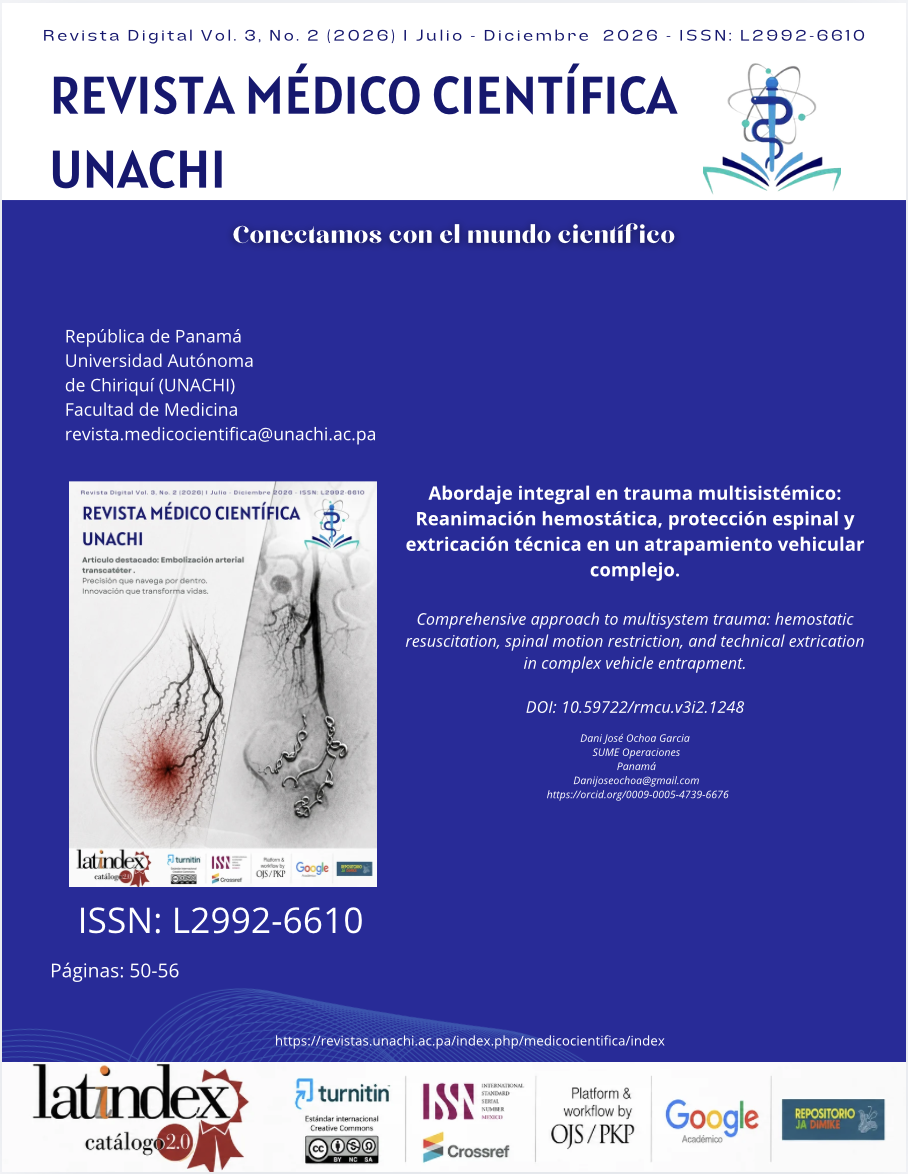
Abordaje integral en trauma multisistémico: reanimación hemostática, protección espinal y extricación técnica en un atrapamiento vehicular complejo.
Comprehensive approach to multisystem trauma: hemostatic resuscitation, spinal motion restriction, and technical extrication in complex vehicle entrapment.
DOI:
https://doi.org/10.59722/rmcu.v3i2.1248Keywords:
trauma multisistémico , atrapamiento vehicular, extricación técnica, reanimación hemostática, ácido tranexámico, torniquete táctico, inmovilización espinal, SUME prehospitalaria, medicina prehospitalariaAbstract
The case documents the prehospital care of a 49-year-old male with Grade III vehicular entrapment and decompensated hypovolemic shock in Chiriquí, Panama. Coordinated intervention among SUME 9-1-1, SAMER, and the Fire Department integrated cervical immobilization, hemostatic resuscitation with tranexamic acid, thermal control, and a 45-minute technical extrication, delivering the patient in stable condition for successful surgery.
Downloads
References
Nutbeam T, Fenwick R, Haldane C, et al. Extrication following a motor vehicle collision: a consensus statement on behalf of the Faculty of Pre-hospital Care, Royal College of Surgeons of Edinburgh. Scand J Trauma Resusc Emerg Med. 2025;33(1):3. Disponible en: https://doi.org/10.1186/s13049-024-01312-z
Nutbeam T, Fenwick R, Hobson C, et al. A Delphi study of rescue and clinical subject matter experts on the extrication of patients following a motor vehicle collision. Scand J Trauma Resusc Emerg Med. 2022;30(1):41. Disponible en: https://doi.org/10.1186/s13049-022-01029-x
Kudo D, Yoshida Y, Kushimoto S. Permissive hypotension/hypotensive resuscitation and restricted/controlled resuscitation in patients with severe trauma. J Intensive Care. 2017;5:11. Disponible en: https://doi.org/10.1186/s40560-016-0202-z
Giannoudi M, Harwood P. Damage control resuscitation: lessons learned. Eur J Trauma Emerg Surg. 2016;42(3):273-278. Disponible en: https://doi.org/10.1007/s00068-015-0628-3
Acharya P, Amin A, Nallamotu S, et al. Prehospital tranexamic acid in trauma patients: a systematic review and meta-analysis of randomized controlled trials. Front Med. 2023;10:1284016. Disponible en: https://doi.org/10.3389/fmed.2023.1284016
Javeed SS, Altawili MA, Almubarak LNA, et al. The effectiveness of prehospital administration of tranexamic acid in reducing mortality in trauma patients: an overview. Cureus. 2023;15(12):e49784. Disponible en: https://doi.org/10.7759/cureus.49784
Laermans J, Singletary EM, Macneil F, et al. Spinal motion restriction for possible traumatic cervical spine injury: a scoping review. Cureus. 2025;17(5):e84393. Disponible en: https://doi.org/10.7759/cureus.84393
Li Y, Tian M, Zhong W, Zou J, Duan X, Si H. Prehospital tranexamic acid decreases early mortality in trauma patients: a systematic review and meta-analysis. Front Med. 2025;12:1552271. Disponible en: https://doi.org/10.3389/fmed.2025.1552271
Cirocchi R, Prigorschi D, Properzi L, Matteucci M, Duro F, Tebala GD, et al. Is the use of tourniquets more advantageous than other bleeding control techniques in patients with limb hemorrhage? A systematic review and meta-analysis. Medicina (Kaunas). 2025;61(1):93. Disponible en: https://doi.org/10.3390/medicina61010093
Ntourakis D, Liasis L. Damage control resuscitation in patients with major trauma: prospects and challenges. J Emerg Crit Care Med. 2020;4:49. Disponible en: https://doi.org/10.21037/jeccm-20-24
Daniels ZM, McCague A, Henken-Siefken A. Extrication as a predictor of outcome in motor vehicle crashes. Cureus. 2025;17(1):e77225. Disponible en: https://doi.org/10.7759/cureus.77225
Published
How to Cite
Issue
Section
License
Copyright (c) 2026 Dani José Ochoa Garcia

This work is licensed under a Creative Commons Attribution-NonCommercial-ShareAlike 4.0 International License.