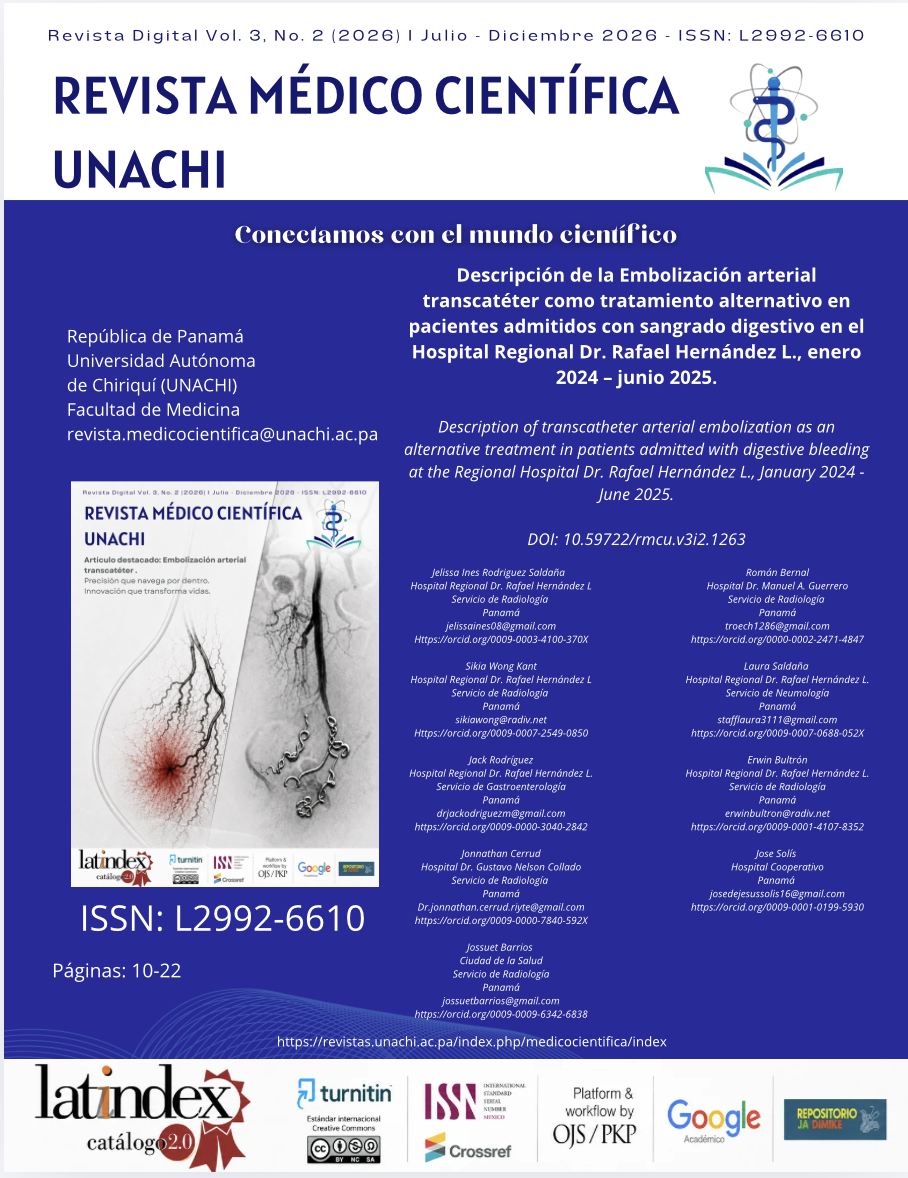
The Description of transcatheter arterial embolization as an alternative treatment in patients admitted with digestive bleeding at the Regional Hospital Dr. Rafael Hernández L., January 2024 - June 2025.
Description of transcatheter arterial embolization as an alternative treatment in patients admitted with digestive bleeding at the Regional Hospital Dr. Rafael Hernández L., January 2024 - June 2025.
DOI:
https://doi.org/10.59722/rmcu.v3i2.1263Keywords:
Gastrointestinal bleeding, embolization, angiography, transcatheter arterial embolizationAbstract
Introduction: Gastrointestinal bleeding (GIB) is a potentially life-threatening clinical condition and a common cause of hospitalization worldwide. Transcatheter Arterial Embolization (TAE) is a minimally invasive therapeutic alternative when primary management fails. In Panama, there is currently no published local evidence regarding its clinical outcomes.
Objective: To describe transcatheter arterial embolization as an alternative treatment in patients admitted with gastrointestinal bleeding at Dr. Rafael Hernández L. Regional Hospital between January 2024 and June 2025.
Methods: A retrospective, descriptive, observational study was conducted through a review of the medical records of patients who underwent TAE as an alternative treatment for gastrointestinal bleeding between January 2024 and June 2025. Gastrointestinal bleeding was confirmed by computed tomography angiography and/or abdominopelvic arteriography. Seventeen patients were initially identified; five were excluded due to portal hypertension-related (variceal) bleeding, resulting in a final sample of 12 patients. Demographic, clinical, angiographic, technical, and outcome variables were analyzed using descriptive statistics.
Results: The predominant age group was 60–79 years (41.7%), with an equal distribution between males and females (6 each). Lower gastrointestinal bleeding was the most frequent presentation (66.7%), with hemorrhoidal disease as the leading etiology. The superior hemorrhoidal arteries were the most commonly embolized vessels (58.3%). Microspheres were the most frequently used embolic agent (50%). Technical success was achieved in 100% of cases, while clinical success was observed in 83.3%. Rebleeding occurred in two patients (16.7%), one minor vascular access-related complication (8.3%) was documented, and in-hospital mortality was 16.7%, with no deaths directly attributable to the procedure. The median hospital stay was 15 days (IQR: 7–24).
Conclusion: Transcatheter arterial embolization was described as an effective alternative treatment for non-variceal gastrointestinal bleeding, achieving a 100% technical success rate, 83.3% clinical success, and a low rate of procedure-related complications in patients treated at Dr. Rafael Hernández L. Regional Hospital between January 2024 and June 2025.
Downloads
References
Saydam ŞS, Molnar M, Vora P. The global epidemiology of upper and lower gastrointestinal bleeding in general population: a systematic review. World J Gastrointest Surg. 2023;15(4):723-739. Disponible en: https://doi.org/10.4240/wjgs.v15.i4.723
Peery AF, Crockett SD, Murphy CC, Jensen ET, Kim HP, Egberg MD, et al. Burden and cost of gastrointestinal, liver, and pancreatic diseases in the United States: update 2021. Gastroenterology. 2022;162(2):621-644. Disponible en: https://doi.org/10.1053/j.gastro.2021.10.017
Lau LHS, Sung JJY. Treatment of upper gastrointestinal bleeding in 2020: new techniques and outcomes. Dig Endosc. 2021;33(1):83-94. Disponible en: https://doi.org/10.1111/den.13674
Radaelli F, Frazzoni L, Repici A, Paggi S, Hassan C, Fuccio L. Clinical management and outcomes of patients with acute lower gastrointestinal bleeding: a prospective multicenter cohort study. Dig Liver Dis. 2021;53(1):12-20. Disponible en: https://doi.org/10.1016/j.dld.2021.01.008
Gross SA. Hemostatic techniques in the management of gastrointestinal bleeding. Gastroenterol Hepatol (N Y). 2024;20(3):183-185. Disponible en: https://pubmed.ncbi.nlm.nih.gov/38680173/
Wortman JR, Landman W, Fulwadhva UP, Viscomi SG, Sodickson AD. CT angiography for acute gastrointestinal bleeding: what the radiologist needs to know. Radiology. 2015;276(3):622-632. Disponible en: https://doi.org/10.1148/radiol.2015142478
Matsumoto T, Yoshimatsu R, Shibata J, Osaki M, Maeda H, Miyatake K, et al. Transcatheter arterial embolization of nonvariceal gastrointestinal bleeding with n-butyl cyanoacrylate or coils: a systematic review and meta-analysis. Sci Rep. 2024;14:27377. Disponible en: https://doi.org/10.1038/s41598-024-79133-4
Kim PH, Tsauo J, Shin JH, Yun SC. Transcatheter arterial embolization of gastrointestinal bleeding with N-butyl cyanoacrylate: a systematic review and meta-analysis of safety and efficacy. J Vasc Interv Radiol. 2017;28(4):522-531.e5. Disponible en: https://doi.org/10.1016/j.jvir.2016.12.1220
Lee S, Kim T, Han SC, Pak H, Jeon HH. Transcatheter arterial embolization for gastrointestinal bleeding: clinical outcomes and prognostic factors predicting mortality. Medicine (Baltimore). 2022;101(31):e29342. Disponible en: https://doi.org/10.1097/MD.0000000000029342
Hosse C, Moos M, Becker LS, Sieren M, Müller L, Stöehr F, et al. Trans-arterial embolization for treatment of acute lower gastrointestinal bleeding: a multicenter analysis. Eur Radiol. 2025;35(5):2746-2754. Disponible en: https://doi.org/10.1007/s00330-024-11102-x
Vorčák M, Sýkora J, Ďuríček M, Bánovčin P, Grendár M, Zeleňák K. Endovascular treatment of gastrointestinal hemorrhage: transcatheter arterial embolization is a minimally invasive method with high technical success in patients with endoscopically untreatable gastrointestinal bleeding. Medicina (Kaunas). 2022;58(3):424. Disponible en: https://doi.org/10.3390/medicina58030424
Montoro M, Muñiz P, Martínez VC. Indications and hemoglobin thresholds for red blood cell transfusion and iron replacement in adults with gastrointestinal bleeding: an expert algorithm. Front Med (Lausanne). 2022;9:903739. Disponible en: https://doi.org/10.3389/fmed.2022.903739
Terrón R, Rodríguez M, Ríos J, Becerra E. Embolización en sangrado digestivo bajo por radiología intervencionista. Cir Cir. 2019;87(3):243-249. Disponible en: https://www.scielo.org.mx/scielo.php?script=sci_arttext&pid=S1870-72032019000300243
Basantes Malusín LE, Quinapallo Mosquera LE, Rodríguez Revelo ME, Rosero Estrella MA. Embolización arterial en hemorragia digestiva baja. RECIMUNDO. 2020;4(2):94-105. Disponible en: https://doi.org/10.26820/recimundo/4.(2).mayo.2020.94-105
Published
How to Cite
Issue
Section
License
Copyright (c) 2026 Jelissa Inés Rodríguez Saldaña, Sikia Wong Kant, Jack Rodríguez, Jonnathan Cerrud, Jossuet Barrios, Román Bernal, Laura Saldaña, Erwin Bultrón, José Solis

This work is licensed under a Creative Commons Attribution-NonCommercial-ShareAlike 4.0 International License.