Intervención educativa de simulación clínica de ritmos cardíacos en el aprendizaje.
Estudiantes de emergencias médicas, Universidad Autónoma de Chiriquí, diciembre del 2023 a noviembre del 2024.
DOI:
https://doi.org/10.59722/rmcu.v2i2.894Keywords:
Ritmos cardíacos, Intervención, Evidencia, Simulación, HabilidadesAbstract
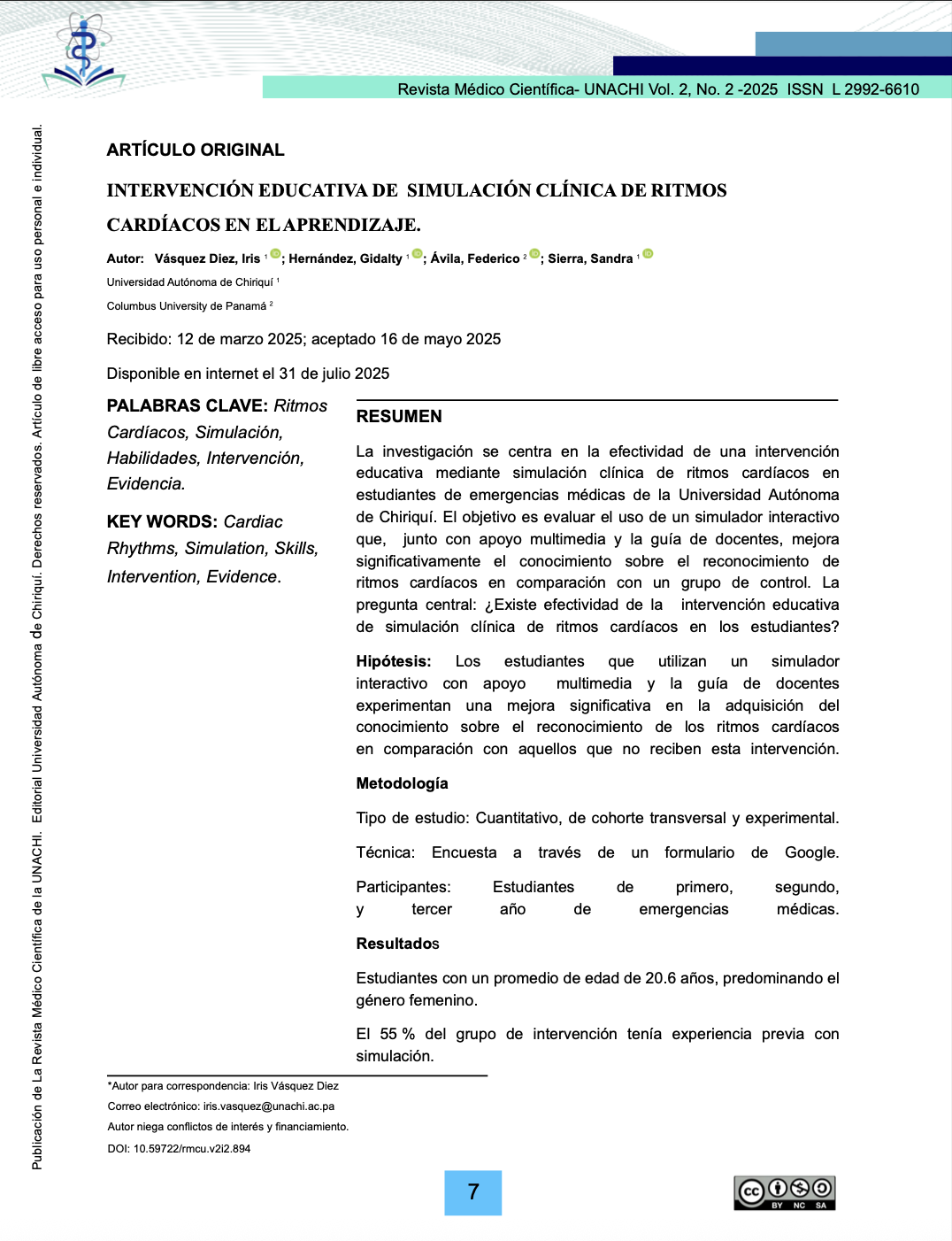
The research focuses on the effectiveness of an educational intervention through clinical simulation of cardiac rhythms among emergency medical students at the Universidad Autónoma de Chiriquí. The goal is to evaluate whether the use of an interactive simulator, along with multimedia support and guidance from instructors, significantly improves knowledge about recognizing cardiac rhythms compared to a control group. The central question is: Is there an effectiveness of the educational intervention of clinical simulation of cardiac rhythms among students?
Hypothesis: Students using an interactive simulator with multimedia support and instructor guidance experience a significant improvement in acquiring knowledge about recognizing cardiac rhythms compared to those who do not receive this intervention.
Methodology
Study type: Quantitative, cross-sectional cohort, and experimental.
Technique: Survey through a Google Form.
Participants: First, second, and third-year emergency medical students.
Results
- Participants had an average age of 20.6 years, with a predominance of the female gender.
- 55 % of the intervention group had prior experience with simulation.
- Both groups showed an average pre-test score of 26.8.
- Significant differences were found in the intervention group (p=0.01) and in the control group (p=0.024), with effect sizes of 0.52 and 0.32, respectively.
- The intervention group demonstrated a greater effect in improving knowledge about cardiac rhythms.
This study suggests that clinical simulation can be an effective method in emergency medical education.
Downloads
Published
How to Cite
Issue
Section
License
Copyright (c) 2025 Dra. Iris Vásquez, Dr. Federico Ávila, Dra. Sandra Sierra, Dra. Gidalty Hernández

This work is licensed under a Creative Commons Attribution-NonCommercial-ShareAlike 4.0 International License.