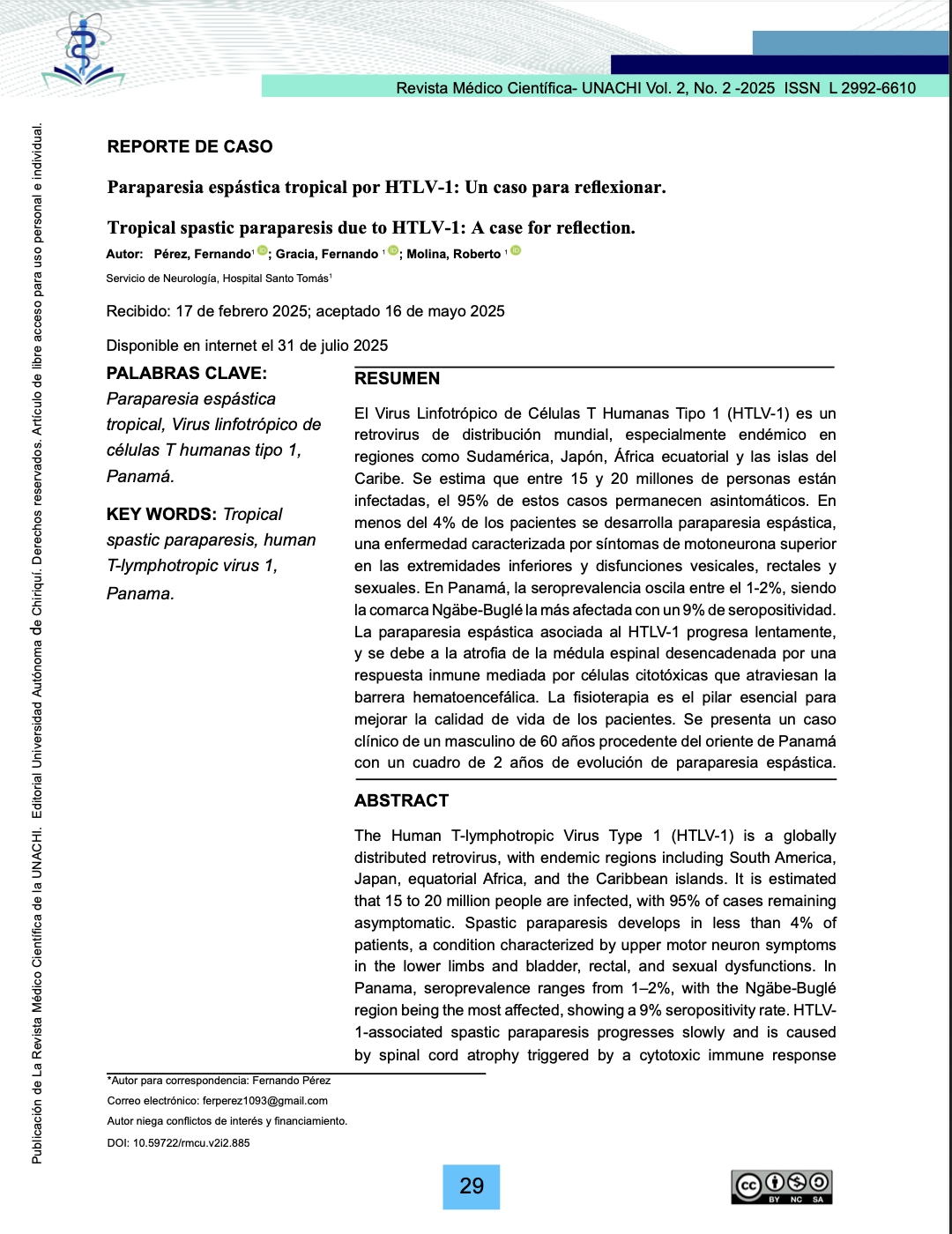
Tropical Spastic Paraparesis due to HTLV-1. A Case for Reflection.
DOI:
https://doi.org/10.59722/rmcu.v2i2.885Keywords:
tropical spastic paraparesis, human T-lymphotropic virus 1, PanamaAbstract
The Human T-lymphotropic Virus Type 1 (HTLV-1) is a globally distributed retrovirus, with endemic regions including South America, Japan, equatorial Africa, and the Caribbean islands. It is estimated that 15 to 20 million people are infected, with 95% of cases remaining asymptomatic. Spastic paraparesis develops in less than 4% of patients, a condition characterized by upper motor neuron symptoms in the lower limbs and bladder, rectal, and sexual dysfunctions. In Panama, seroprevalence ranges from 1–2%, with the Ngäbe-Buglé region being the most affected, showing a 9% seropositivity rate. HTLV-1-associated spastic paraparesis progresses slowly and is caused by spinal cord atrophy triggered by a cytotoxic immune response that crosses the blood-brain barrier. Physical therapy is the cornerstone for improving patients' quality of life. We present the clinical case of a 60-year-old male originating from eastern Panamawith a two-year history of spastic paraparesis.
Downloads
Published
How to Cite
Issue
Section
License
Copyright (c) 2025 Fernando Pérez, Fernando Gracia, Roberto Molina

This work is licensed under a Creative Commons Attribution-NonCommercial-ShareAlike 4.0 International License.